

Why Your Therapist Website Can Rank in Google but Still Be Invisible in AI Search
Your therapist website may already rank well in Google—but that doesn’t necessarily mean it will appear in AI-generated search results.
This is becoming an increasingly important issue for therapists, psychologists, psychotherapists, counselors, and mental health professionals who rely on their websites to attract new clients.
Traditional Google SEO focuses heavily on helping your website appear in search results for specific keywords.
AI search is different.
When someone asks an AI search engine:
“Who are the best therapists for anxiety in Munich?”
or:
“I’m looking for an English-speaking therapist in Berlin who specializes in burnout and offers online therapy. Who should I consider?”
the system isn’t simply looking for a webpage containing the exact keyword.
It needs to understand:
- Who you are
- What you specialize in
- Where you work
- Who you help
- What services you provide
- What languages you speak
- Whether you offer online therapy
- What makes your practice trustworthy
- Whether your website provides enough useful information to support an answer
That is why a therapist website can rank on page one of Google and still have little or no visibility in AI-generated answers.
Let’s look at why this happens—and what you can do about it.
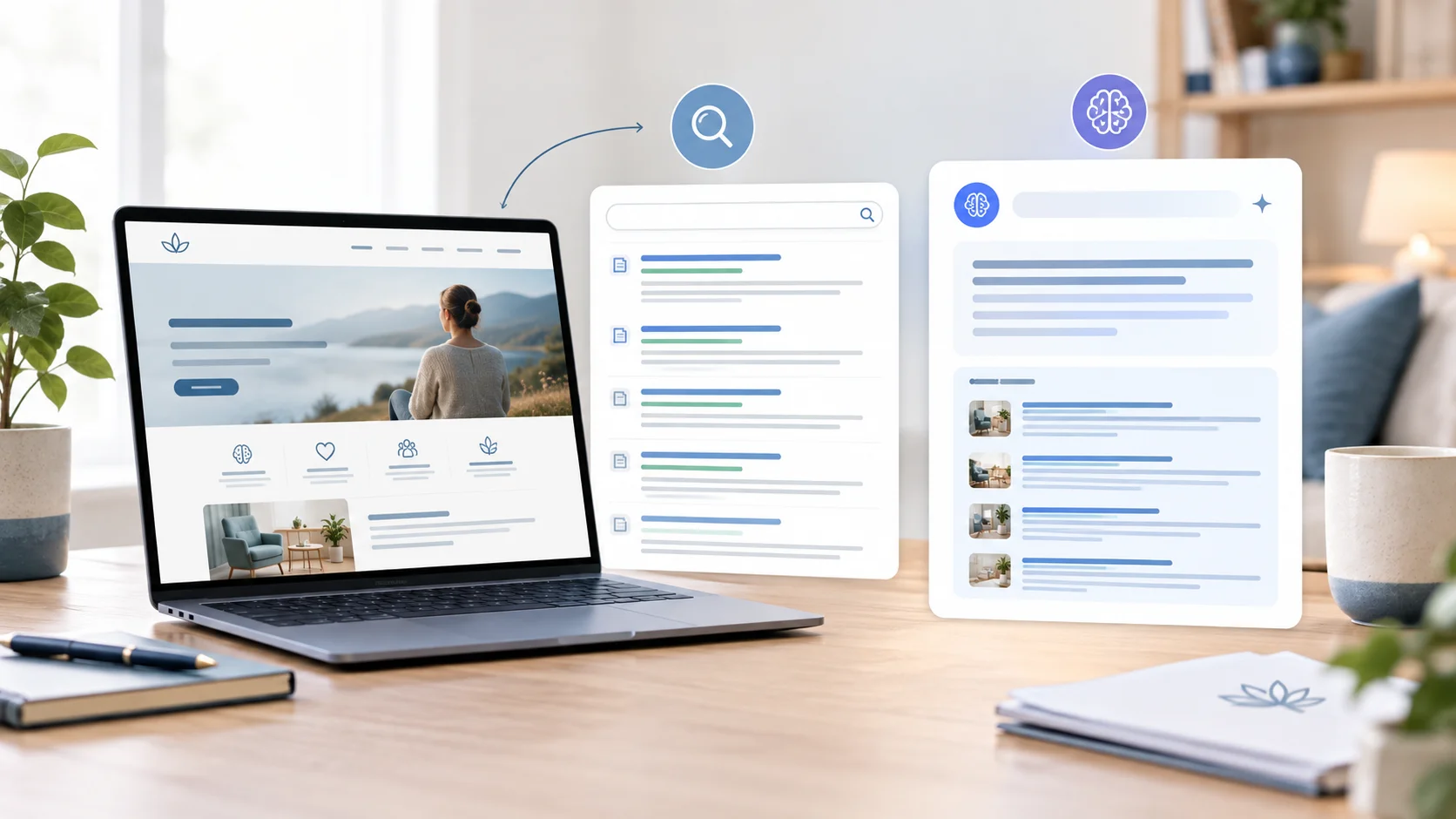
Google Rankings and AI Visibility Are Not the Same Thing
One of the biggest misconceptions about modern search is:
“If my website ranks on Google, AI search will automatically find me.”
Not necessarily.
Google rankings and AI-generated answers involve different systems, signals, and retrieval processes.
Traditional SEO considers factors such as:
- Search intent
- Content relevance
- Technical SEO
- Website structure
- Page quality
- Links and authority
- Local relevance
- User experience
- Query matching
AI-powered search adds another layer.
AI systems need to understand information about your practice and determine whether your website is relevant to a conversational question.
For a therapist, your website needs to communicate much more than:
“I am a therapist in Berlin.”
It should clearly explain:
- Who you are
- Your professional qualifications
- Your therapeutic approach
- Your areas of specialization
- The problems you help with
- Your location
- Whether you offer online therapy
- Which languages you speak
- Who your services are suitable for
- How therapy works
- How potential clients can contact you
The goal isn’t to manipulate AI systems.
The goal is to make your website easy for both humans and machines to understand.
What Is AI Search?
AI search refers to search experiences where artificial intelligence generates, summarizes, or assists with answers instead of simply displaying a traditional list of links.
Examples include AI-powered search experiences such as:
- Google AI Overviews
- ChatGPT search
- Microsoft Copilot
- Perplexity
- Other AI-powered answer engines
Instead of typing:
“therapist Munich anxiety”
a potential client might ask:
“I’m looking for an English-speaking therapist in Munich who specializes in anxiety and offers online appointments. What options are available?”
This is a much more complex search.
The system needs to understand several concepts at the same time:
Profession + Location + Language + Specialization + Service + Format
Your website needs to make these relationships clear.
Why Can a Therapist Website Rank in Google but Remain Invisible in AI Search?
There isn’t just one reason.
Usually, it is a combination of content, structure, authority, entity information, technical SEO, and how clearly the practice is represented online.
Here are some of the most common problems.
1. Your Website Is Optimized for Keywords Instead of Questions
Traditional SEO often starts with keyword research.
For example:
- Therapist Munich
- Psychotherapy Berlin
- Anxiety therapy Hamburg
- Psychologist Frankfurt
These keywords are still important.
But AI search users often communicate differently.
They ask complete questions.
For example:
- How can therapy help with anxiety?
- What type of therapy is suitable for burnout?
- Where can I find a therapist in Munich who speaks English?
- Do therapists in Berlin offer online sessions?
- What should I expect during my first therapy session?
- How do I know if I need therapy?
If your website only contains short service pages targeting individual keywords, an AI system may have very little useful information to work with.
What should you do?
Create content that directly answers the questions your potential clients actually ask.
Instead of creating a page that simply targets:
“Anxiety Therapy Munich”
create a genuinely useful page that answers questions such as:
What Is Anxiety Therapy?
Explain the concept in clear, accessible language.
Who Can Benefit From Anxiety Therapy?
Explain the types of concerns and situations you work with.
How Does Anxiety Therapy Work?
Explain your therapeutic approach without making unrealistic promises.
When Should Someone Consider Professional Support?
Provide responsible, useful information.
Do You Offer Online Anxiety Therapy?
Answer the practical question directly.
This creates content that is useful for people and easier for search and answer engines to understand.
2. Your Website Doesn’t Clearly Establish Who You Are
AI systems need context.
A website saying:
“Welcome to my practice. I offer professional therapy.”
doesn’t provide much information.
Compare that with:
“Anna Müller is a psychotherapist based in Munich specializing in anxiety, stress, burnout, and relationship difficulties. She offers individual therapy for adults in German and English, both in-person in Munich and online.”
The second example communicates several important entities and relationships:
Person: Anna Müller
Profession: Psychotherapist
Location: Munich
Specializations: Anxiety, stress, burnout, relationships
Audience: Adults
Languages: German and English
Service: Individual therapy
Format: In-person and online
That information is much easier for machines to interpret.
This is where entity SEO becomes important.
Your website should establish a consistent digital identity for your professional practice.
Your name, professional credentials, location, services, specialties, social profiles, professional directories, and other reputable references should ideally provide consistent information.
3. Your Services Are Too Vague
Another common problem is generic service descriptions.
For example:
“I offer individual therapy and counseling for different psychological issues.”
This doesn’t tell a potential client—or a search system—very much.
A stronger service page could explain:
- What the service is
- Who it is for
- Which concerns it addresses
- Your therapeutic approach
- Session format
- Location
- Language
- Online or in-person availability
- What clients can expect
- How to get started
For example:
Therapy for Burnout
“I provide individual therapy for adults experiencing emotional exhaustion, chronic stress, work-related burnout, difficulty setting boundaries, and reduced motivation. Sessions are available in Munich and online.”
This is much more specific.
Search engines and AI systems can now understand the relationship between:
Therapist → Burnout → Adults → Munich → Online Therapy
4. Your Website Doesn’t Answer Follow-Up Questions
AI search is conversational.
One question often leads to another.
A potential client might ask:
“Who offers anxiety therapy in Munich?”
Then:
“Does this therapist work with adults?”
Then:
“Do they offer online sessions?”
Then:
“What type of therapy do they use?”
Then:
“How can I contact them?”
If your website answers only the first question, it may not provide enough information to support the entire conversation.
This is why comprehensive service pages and FAQ sections can be extremely valuable.
Your website should anticipate the questions a potential client is likely to ask before contacting you.
5. Your FAQ Section Is Missing—or Too Generic
FAQ content can be particularly useful for therapist websites because potential clients naturally have many questions before contacting a professional.
Useful questions can include:
About Therapy
- What happens during the first therapy session?
- How long does a therapy session last?
- How often should I attend therapy?
- How do I know whether therapy is right for me?
About Your Specializations
- How can therapy help with anxiety?
- Do you work with burnout?
- Do you provide support for relationship difficulties?
- Do you work with stress-related problems?
Practical Questions
- Do you offer online therapy?
- Which languages do you offer therapy in?
- Where is your practice located?
- How can I book an appointment?
- What should I do if I need urgent psychological support?
The answers should be clear, factual, empathetic, and genuinely useful.
Don’t create FAQs simply to insert keywords.
Create them because they help potential clients.
6. Your Website Doesn’t Demonstrate Enough Professional Expertise
Mental health is a sensitive topic.
People aren’t simply looking for a webpage.
They’re looking for someone they can trust.
Your website should therefore clearly communicate your professional expertise.
Depending on your profession and applicable regulations, this may include:
- Professional title
- Qualifications
- Training
- Certifications
- Therapeutic modalities
- Professional memberships
- Relevant experience
- Areas of specialization
- Languages
- Practice location
- Publications
- Professional presentations or speaking engagements
Your About page shouldn’t be nothing more than a short biography.
Explain:
Who you are.
Who you help.
How you work.
What clients can expect.
This provides useful context for both potential clients and search systems.
7. Your Website Has Weak E-E-A-T Signals
Google’s search quality guidance uses the concepts of:
Experience, Expertise, Authoritativeness, and Trustworthiness.
These concepts are particularly relevant to health and mental health content because people may make important decisions based on what they read online.
Your website should make it easy to understand and verify relevant information about your professional practice.
Experience
Show relevant professional experience where appropriate.
Expertise
Clearly explain your qualifications, training, and areas of professional expertise.
Authoritativeness
Build legitimate recognition through professional organizations, publications, interviews, educational institutions, and other relevant sources where applicable.
Trustworthiness
Make your identity, contact information, professional credentials, practice details, and policies transparent.
Most importantly:
Don’t manufacture authority.
Don’t buy fake reviews.
Don’t create fake professional profiles.
Don’t publish fabricated qualifications.
Don’t use misleading claims.
Build genuine professional trust.
8. Your Local SEO Is Weak
Most therapists serve a particular geographic area.
That makes local SEO extremely important.
A therapist in Munich may want visibility for searches such as:
- Therapist Munich
- Psychotherapist Munich
- Anxiety therapy Munich
- Burnout therapy Munich
- English-speaking therapist Munich
- Online therapy Germany
Your website should clearly communicate your geographic relevance.
Depending on your practice, include accurate information about:
- City
- Neighborhood or service area
- Practice address
- Service areas
- Online therapy availability
- Languages
- Local contact information
Your Google Business Profile and relevant professional directories should also be consistent with the information on your website.
9. Your Website’s Structured Data Is Missing or Incorrect
Search engines don’t only process the visible words on your website.
They can also process structured data.
For a therapist website, relevant Schema.org markup may help clarify entities and relationships such as:
- Person
- Organization
- ProfessionalService
- Service
- WebSite
- WebPage
- BreadcrumbList
- FAQPage
The correct schema depends on the actual professional practice and the information genuinely presented on the website.
Structured data should always accurately represent the visible and verifiable information on the page.
Think of Schema as context—not a ranking shortcut.
Well-implemented JSON-LD can help clarify relationships such as:
Professional → Practice → Service → Location → Website
However, schema alone will not guarantee higher rankings or AI visibility.
10. Your Website Has Little Supporting Authority Around It
Your website doesn’t exist in isolation.
Search and AI systems may encounter information about your professional practice across multiple sources.
For example:
- Professional directories
- Psychology associations
- University profiles
- Conference websites
- Publications
- Interviews
- Local organizations
- Reputable business directories
- Professional social profiles
If your website says one thing while reputable external sources say something completely different, your professional identity becomes less clear.
For example:
Website: Anna Müller — Psychotherapist — Munich
Directory: Anna Müller — Counselor — Berlin
Professional profile: Anna M. — Psychologist — Hamburg
Inconsistent information can create ambiguity.
Your professional information should therefore be as consistent as possible across legitimate sources.
11. Your Website Content Is Difficult for AI to Understand
Some therapist websites look beautiful but communicate very little useful information.
For example, a homepage might say:
“Healing begins within.”
“A new chapter starts here.”
“Discover your path.”
These statements can create a warm emotional atmosphere.
But they don’t answer the questions a potential client needs to know.
Who are you?
What do you offer?
Where are you located?
Who do you help?
What problems do you specialize in?
What therapeutic approach do you use?
Do you offer online sessions?
How can someone contact you?
Beautiful design and clear information should work together.
12. Your Blog Content Is Too Generic
Many therapist websites publish articles such as:
- 5 Ways to Reduce Stress
- How to Feel Better
- Tips for Mental Health
- Understanding Anxiety
- How to Manage Stress
These aren’t necessarily bad topics.
But they’re extremely broad.
Instead, create content around specific client questions and your genuine professional expertise.
For example:
Instead of:
How to Reduce Stress
Consider:
How Therapy Can Help With Chronic Work-Related Stress
Or:
Instead of:
Understanding Anxiety
Consider:
When Should You Consider Therapy for Anxiety?
Or:
Instead of:
What Is Burnout?
Consider:
How Therapy Can Help Adults Recover From Work-Related Burnout
Specific questions create stronger topical relationships between your expertise, services, and client needs.
13. You Don’t Have Enough First-Hand Expertise in Your Content
AI-generated content has made the internet much more crowded.
Publishing dozens of generic articles based on the same publicly available information doesn’t necessarily make a therapist more authoritative.
Your strongest advantage is often your genuine professional experience.
You can create useful content around:
- Common questions you receive
- Common misconceptions
- How you approach therapy
- What clients should know before their first session
- How different therapy approaches work
- How different therapeutic approaches differ
- Common mistakes people make when seeking therapy
- What clients should consider when choosing a therapist
Always protect client confidentiality.
Never disclose identifiable client information.
Your professional knowledge and experience can make your content significantly more valuable than generic content produced solely to target keywords.
14. Technical SEO May Be Preventing Important Pages From Being Discovered
Content isn’t the only issue.
Technical problems can make important pages difficult for search engines to crawl, understand, or index.
Check:
- Robots.txt
- XML sitemap
- Canonical URLs
- Indexability
- Noindex directives
- HTTP status codes
- Redirects
- JavaScript rendering
- Internal links
- Mobile usability
- Page speed
- Core Web Vitals
- HTTPS
- Duplicate content
- Broken links
- Server accessibility
A beautiful website doesn’t help if important pages can’t be properly crawled and indexed.
Technical SEO remains the foundation of every successful search visibility strategy.
15. Your Internal Linking Structure Is Weak
Internal links help search engines understand the relationship between your pages.
Imagine a therapist website structured like this:
Homepage
↓
Anxiety Therapy
↓
Anxiety and Panic Attacks
↓
How Therapy Can Help With Anxiety
↓
Frequently Asked Questions
↓
Book a Consultation
This creates a clear topical structure.
Your internal links should connect related content naturally.
For example:
Anxiety Therapy → Anxiety Symptoms → Treatment Approach → FAQ → Contact
This helps users navigate the website while also reinforcing the relationship between related topics.
[IMAGE: Therapist website entity and content structure]
Suggested image alt text: Therapist website SEO structure connecting services specialties location and FAQ content
Traditional SEO vs AI Search Optimization
The difference can be summarized like this:
| Traditional SEO | AI Search / AEO / GEO |
|---|---|
| Keywords | Questions and intent |
| Search rankings | Inclusion in AI answers |
| Individual pages | Connected information |
| Keyword relevance | Contextual relevance |
| Backlinks | Authority and entity signals |
| Search snippets | Answer-ready content |
| Local rankings | Location and professional context |
| Page optimization | Entity and topic optimization |
| Search clicks | Mentions, citations and recommendations |
| Keywords first | User questions first |
This doesn’t mean traditional SEO is dead.
It means traditional SEO is becoming the foundation of a broader search strategy.
How to Make Your Therapist Website More Visible in AI Search
The solution isn’t to create hundreds of AI-generated pages.
Instead, build a website that is:
Technically accessible + semantically clear + professionally authoritative + genuinely useful.
Here is a practical framework.
Step 1: Clearly Define Your Professional Identity
Your website should clearly establish:
Who you are + what you do + where you work + who you help.
Your homepage should communicate these things quickly.
A potential client shouldn’t have to search through five pages to discover what type of therapist you are.
Step 2: Build Dedicated Service Pages
Create dedicated pages for your major services.
For example:
- Anxiety Therapy
- Depression Therapy
- Burnout Therapy
- Couples Therapy
- Trauma Therapy
- Stress Management
- Online Therapy
Only create pages for services you genuinely provide.
Each service page should provide meaningful information rather than simply repeating a target keyword.
Step 3: Create Location-Relevant Content
If local clients are important to your practice, make your geographic relevance clear.
For example:
Therapist in Munich
Anxiety Therapy in Munich
English-Speaking Therapist in Munich
However, avoid creating dozens of nearly identical location pages.
Every location page should provide genuine value.
Step 4: Build Question-Based Content
Research the questions your potential clients actually ask.
Then create useful answers.
A strong structure is:
Question → Explanation → Professional insight → Practical information → Relevant service → Next step
This structure is useful for humans, search engines, and answer engines.
Step 5: Add Professional Author Information
Expert articles should clearly identify their author.
Where appropriate, include:
Written by:
Professional name
Credentials:
Relevant qualifications
Reviewed by:
Qualified professional, when applicable
Last updated:
Date
This improves transparency and helps establish who is responsible for the information.
Step 6: Implement Relevant Schema Markup
Use accurate structured data to clarify the entities represented on your website.
Depending on the website, this may include:
- Person
- Organization
- ProfessionalService
- Service
- WebSite
- WebPage
- BreadcrumbList
- FAQPage
Don’t add schema simply because a plugin offers it.
The markup should accurately represent the information on the website.
Step 7: Strengthen Your Online Professional Entity
Make sure your professional information is consistent across legitimate platforms.
Check information such as:
Name
Professional title
Qualifications
Location
Services
Languages
Website
Professional profiles
Consistency helps establish a clearer digital identity.
Step 8: Make Your Content Easy to Understand and Reference
AI systems need reliable information to answer questions.
Write clear statements that can stand on their own.
Instead of only saying:
“We believe everyone deserves support.”
also provide factual information such as:
“I provide individual psychotherapy for adults experiencing anxiety, burnout, and work-related stress in Munich and online.”
The second statement contains specific information that can be understood independently.
Step 9: Don’t Forget Google
AI search optimization does not mean abandoning Google.
Your strategy should work across traditional and AI-powered search.
Continue investing in:
- Technical SEO
- Local SEO
- On-page SEO
- Helpful content
- Internal linking
- Structured data
- Page speed
- Google Search Console
- Google Business Profile
- Legitimate authority building
Think of modern search as:
SEO + AEO + GEO + Entity Optimization
rather than SEO versus AI search.
Step 10: Measure More Than Rankings
Traditional SEO reporting often focuses on:
“What position does my keyword have?”
That’s still useful.
But modern visibility requires a broader set of signals.
Track:
- Organic impressions
- Organic clicks
- Branded searches
- Local visibility
- Referral traffic
- Conversion rates
- Contact form submissions
- Appointment requests
- Important service-page visibility
- AI search visibility where measurable
- Brand and entity visibility
The ultimate goal isn’t simply:
“Rank #1.”
The goal is:
“Be discovered, understood, trusted, and chosen.”
A Simple Example: Two Therapist Websites
Imagine two therapists in Berlin.
Therapist A
Their website says:
“Welcome to my psychotherapy practice. I offer professional support in a safe and confidential environment.”
The website looks beautiful.
It ranks for:
psychotherapist Berlin
But there is little information about:
- Specializations
- Qualifications
- Languages
- Therapeutic approach
- Services
- Online therapy
- Client questions
Therapist B
Their website clearly explains:
“Dr. Maria Schmidt is a psychotherapist in Berlin specializing in anxiety, burnout, stress-related difficulties, and relationship problems. She provides individual therapy for adults in German and English, with both in-person sessions in Berlin and online appointments.”
The website also includes:
- Detailed service pages
- Professional credentials
- Author information
- FAQ content
- Local information
- Relevant structured data
- Helpful expert articles
- Consistent professional profiles
- Clear contact information
Which website is easier for an AI system to understand?
Therapist B.
The important difference isn’t keyword stuffing.
It’s clarity, context, completeness, and trust.
AI Search Optimization Is Not About “Tricking” AI
There is no reliable shortcut that guarantees an AI system will recommend your practice.
Be skeptical of anyone promising:
“We can guarantee ChatGPT will recommend your therapist website.”
AI systems change.
Their retrieval systems, algorithms, and search experiences continue to evolve.
Results can also vary based on the query, location, language, user context, and many other factors.
Instead of trying to manipulate the system, build a website that deserves to be discovered.
That means:
Be clear.
Be accurate.
Be useful.
Show genuine expertise.
Make your professional identity easy to understand.
Keep information consistent.
Build legitimate authority.
The Future of Therapist SEO Is Search Everywhere
Your potential clients won’t always discover your practice by clicking a traditional blue Google result.
They may discover you through:
- Google Search
- AI-generated search results
- ChatGPT
- Perplexity
- Voice assistants
- Google Maps
- Professional directories
- Social platforms
- Online recommendations
- Local search
Your website should therefore become more than an online business card.
It should become a trusted information source about your professional expertise and services.
Final Takeaway
If your therapist website ranks in Google but doesn’t appear in AI-generated answers, that doesn’t necessarily mean your SEO has failed.
It may mean your website was optimized primarily for ranking, rather than for understanding and recommendation.
Modern search requires a broader approach.
Your website should clearly communicate:
Who you are.
What you specialize in.
Who you help.
Where you work.
How you work.
Why clients can trust you.
What questions you can answer.
How someone can take the next step.
Traditional SEO remains important—but it is increasingly becoming one part of a larger search visibility strategy.
For therapists, psychologists, and mental health professionals, the opportunity is significant.
Don’t just optimize your website to rank. Optimize it to be understood, trusted, and discoverable wherever people search—including AI-powered search.
Frequently Asked Questions
Can a website rank on Google but not appear in ChatGPT or other AI search results?
Yes.
Traditional search rankings and AI-generated recommendations use different systems and signals.
A website can have strong Google visibility while lacking the contextual information, authority, or relevance needed to be surfaced for a particular AI-generated question.
Does SEO still matter for AI search?
Yes.
Technical SEO, crawlability, indexing, quality content, internal linking, authority, and structured information remain important foundations.
AI search optimization should complement—not replace—traditional SEO.
What is GEO for therapist websites?
GEO, or Generative Engine Optimization, focuses on improving how a website and its information can be understood and potentially surfaced by generative AI and answer engines.
For therapists, this can include clear professional expertise, services, locations, entities, question-based content, structured information, and trustworthy supporting sources.
What is AEO?
AEO stands for Answer Engine Optimization.
It focuses on creating content that directly and clearly answers the questions people ask search engines, voice assistants, and AI-powered answer systems.
Does adding Schema make a therapist website appear in ChatGPT?
No.
Schema markup is not a guarantee of AI visibility.
It can help search engines understand information about a website and its entities, but visibility depends on many other factors.
Should therapists create hundreds of AI-generated blog posts?
No.
Publishing large amounts of generic or repetitive content can create a website full of low-value information.
A better strategy is to publish genuinely useful content based on real client questions and the therapist’s professional expertise.
What information should a therapist website clearly display?
At minimum, the website should clearly communicate the professional’s identity, qualifications, services, specialties, location, languages, therapy format, relevant professional information, contact options, and useful information about the therapeutic process.
How can I check whether my therapist website is ready for AI search?
Start with a combined SEO, AEO, GEO, entity, and technical audit.
Check whether search engines can crawl and index the site, whether your professional identity is clearly defined, whether services and locations are explicit, whether important client questions are answered, whether structured data is accurate, and whether your professional information is consistent across reputable external sources.
Is AI search optimization the same as traditional SEO?
No.
There is significant overlap, but AI search optimization places greater emphasis on contextual understanding, entities, conversational questions, clear answers, professional authority, and information that can be reliably interpreted and connected across sources.
The strongest strategy is not to choose between SEO and AI optimization.
It is to build a website that performs well in traditional search, local search, answer engines, and AI-powered search experiences.