

If you are a therapist, psychotherapist, psychological counsellor, or mental health professional in Germany, having a professional website is only the first step.
Your website also needs to be easy for Google to crawl, easy for potential clients to understand, and easy for search engines and AI systems to recognize as trustworthy and relevant.
Yet, when auditing therapist websites in Germany, I repeatedly see the same SEO problems.
Some websites look beautiful but are almost invisible in Google. Others have good content but weak technical foundations. And many target broad keywords such as Therapie or Psychotherapie without clearly explaining who they help, where they work, and what type of support they provide.
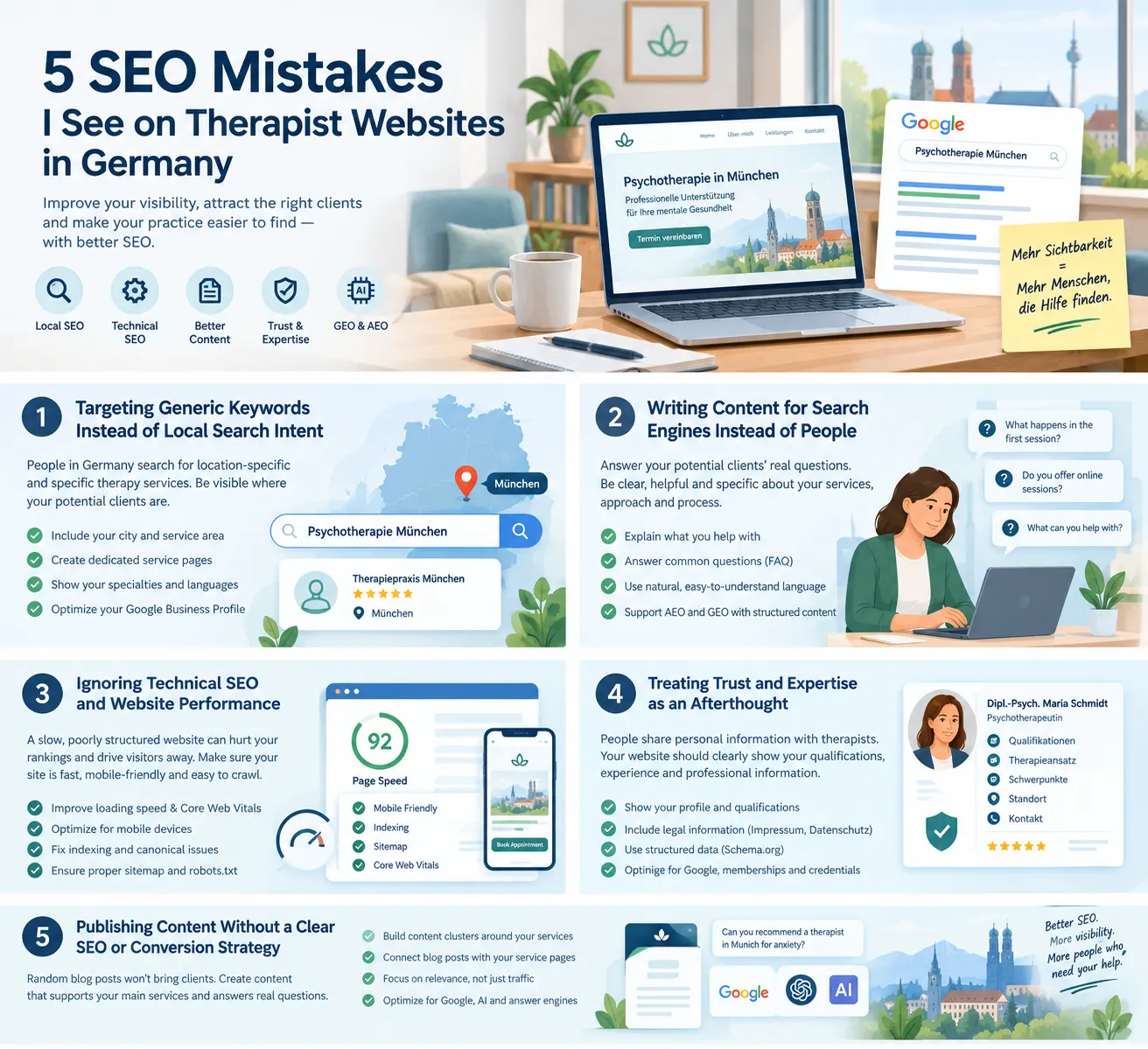
Here are five of the most common SEO mistakes I see—and what you can do instead.
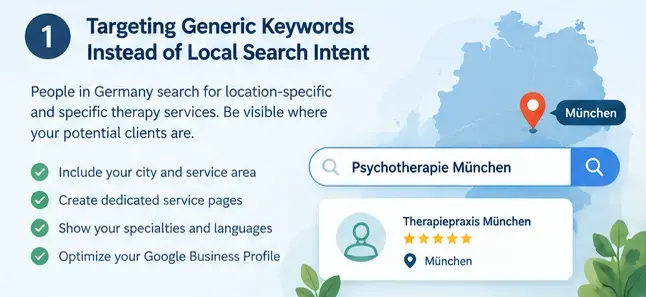
1. Targeting Generic Keywords Instead of Local Search Intent
One of the biggest SEO mistakes is trying to rank for extremely broad keywords.
For example:
- Psychotherapie
- Therapeut
- Psychologe
- Therapie
- Psychotherapie Deutschland
These keywords may have significant search volume, but they are often far too broad for an individual therapist or private practice.
A therapist in Munich, for example, doesn’t necessarily need to compete with websites across all of Germany.
Their potential clients are much more likely to search for something like:
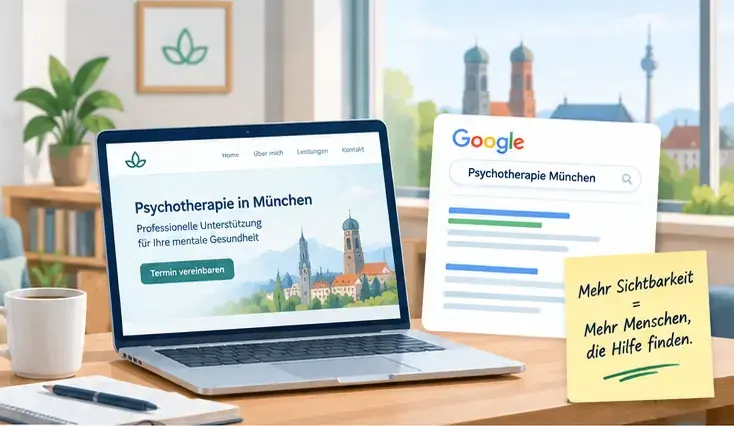
- Psychotherapie München
- Psychotherapeut München
- Therapeut München
- Psychotherapie in München
- Verhaltenstherapie München
- Systemische Therapie München
- Psychologische Beratung München
- Paartherapie München
- Angsttherapie München
- Therapie bei Depressionen München
Why local SEO matters for therapists
Therapy is usually a highly local service.
Someone searching for a therapist often wants to know:
“Who can help me near where I live or work?”
This makes location an important part of search intent.
Your website should therefore clearly communicate:
- City
- District or neighborhood, where appropriate
- Service area
- Therapy approach
- Types of concerns you work with
- In-person or online sessions
- Languages offered
- Relevant qualifications
- How potential clients can contact you
For example, instead of creating a page that simply says:
Psychotherapie
A stronger page could communicate:
Psychotherapie in München – Individuelle Unterstützung bei Angst, Stress und persönlichen Krisen
The goal isn’t to stuff the location into every sentence.
The goal is to make the relevance obvious to both the visitor and the search engine.
Better approach: Build pages around search intent
Consider creating dedicated, genuinely useful pages for important services and locations.
For example:
Core service pages
- Psychotherapie
- Psychologische Beratung
- Paartherapie
- Systemische Therapie
- Verhaltenstherapie
Condition/problem-focused pages
- Therapie bei Angststörungen
- Unterstützung bei Burnout und Stress
- Therapie bei Depressionen
- Hilfe bei Panikattacken
Local pages
- Psychotherapie in München
- Psychotherapie in Berlin
- Psychotherapie in Hamburg
However, don’t create dozens of almost identical city pages simply to manipulate rankings.
Each local page should provide real, useful information about serving clients in that location.

2. Writing Content for Search Engines Instead of People
Another common problem is thin, generic website content.
A therapist’s homepage may contain only a few sentences:
“Welcome to my practice. I offer professional psychological support in a safe and confidential environment.”
It sounds professional—but it doesn’t answer many of the questions a potential client actually has.
Someone looking for a therapist may want to know:
- What problems can you help with?
- What type of therapy do you offer?
- Who is your approach suitable for?
- Do you offer online sessions?
- Where is the practice located?
- What happens during the first appointment?
- How can someone request an appointment?
- What languages do you speak?
- Do you work with adults, adolescents, couples, or families?
- What can someone expect from therapy?
Your website should answer these questions clearly
Think of every important page as a conversation with a potential client.
Instead of:
“I provide individualized therapeutic support.”
Explain what that actually means.
For example:
“I support adults experiencing anxiety, persistent stress, emotional difficulties, and challenging life transitions. In our sessions, we explore the factors contributing to your current situation and develop practical strategies that fit your individual circumstances.”
This is more useful because it gives the visitor context.
This also helps AI and answer engines
Modern search isn’t limited to traditional blue Google links.
People increasingly ask questions through AI-powered search and answer engines.
For example:
“How do I find a psychotherapist in Munich for anxiety?”
or:
“What should I expect from the first psychotherapy session in Germany?”
A website with clearly structured, comprehensive answers gives search systems more useful information to understand and potentially reference.
This is where AEO (Answer Engine Optimization) and GEO (Generative Engine Optimization) become increasingly important.
Use question-based content
Consider adding sections such as:
Who is psychotherapy suitable for?
How does the first therapy session work?
How can I find a therapist in Munich?
What happens during an initial consultation?
Do you offer online psychotherapy sessions?
How long does a therapy session last?
Answer each question directly and naturally.
Don’t write content simply to increase word count.
Write content that helps someone make a better decision.
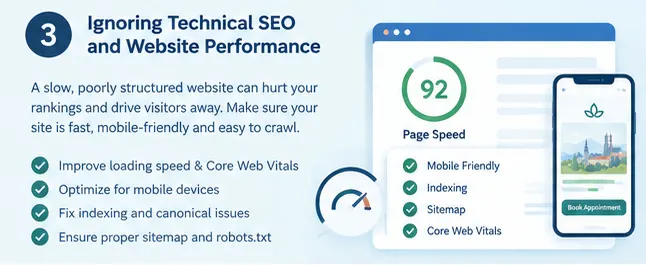
3. Ignoring Technical SEO and Website Performance
A beautiful therapist website can still perform poorly in search if the technical foundation is weak.
I regularly see issues such as:
- Slow loading pages
- Poor mobile performance
- Incorrect canonical URLs
- Broken internal links
- Missing XML sitemaps
- Indexing problems
- Duplicate pages
- Incorrect redirects
- Missing or poorly configured robots.txt
- Images that are unnecessarily large
- JavaScript or CSS blocking rendering
- Poor Core Web Vitals
- Pages that Google cannot properly crawl
Why speed matters
Imagine someone searching for a therapist on their smartphone.
They click your website.
The page takes several seconds to load.
They leave.
That visitor may never return.
Performance is therefore not just an SEO issue. It is also a user-experience and conversion issue.
Pay particular attention to mobile
Therapist websites should work exceptionally well on smartphones.
Check:
- Font size
- Button size
- Navigation
- Contact forms
- Appointment links
- Page loading speed
- Image sizes
- Layout stability
- Accessibility
- Mobile spacing
A visitor shouldn’t have to pinch and zoom just to find your phone number or appointment button.
Check Core Web Vitals
Google’s Core Web Vitals provide useful signals around real-world page experience.
Important metrics include:
- LCP – Largest Contentful Paint
- INP – Interaction to Next Paint
- CLS – Cumulative Layout Shift
Don’t obsess over a perfect score at the expense of usability.
Instead, focus on building a website that loads quickly, responds smoothly, remains visually stable, and works well on real devices.
Technical SEO checklist for a therapist website
At minimum, verify:
Crawling
- Google can crawl important pages
- robots.txt isn’t accidentally blocking content
- XML sitemap is accessible
Indexing
- Important pages are indexable
- No accidental
noindexdirectives - Canonical URLs are correctly configured
Architecture
- Logical URL structure
- Clear internal linking
- Important pages aren’t buried several clicks deep
Performance
- Optimized images
- Efficient caching
- Lightweight page builders and plugins
- Good Core Web Vitals
Mobile
- Responsive design
- Easy-to-use navigation
- Accessible contact and booking buttons
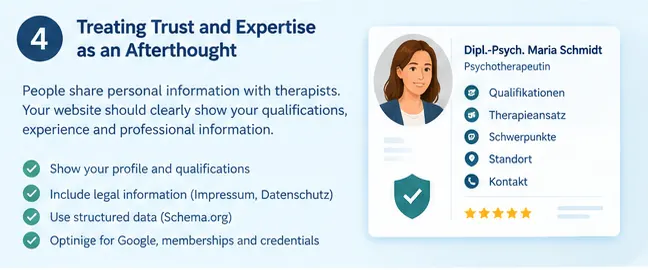
4. Treating Trust and Expertise as an Afterthought
For therapist websites, trust is especially important.
Someone searching for psychological support isn’t simply choosing a restaurant or buying a pair of shoes.
They are potentially sharing deeply personal information with a professional.
Your website needs to communicate:
Who are you?
What are your qualifications?
What do you specialize in?
How do you work?
Where are you located?
How can someone contact you?
Make your professional information easy to find
Depending on your profession and applicable German requirements, your website may need to provide important professional and legal information.
Consider clearly presenting relevant details such as:
- Professional name
- Professional role
- Qualifications
- Relevant training
- Areas of specialization
- Professional memberships, where applicable
- Practice location
- Contact information
- Legal notice / Impressum
- Privacy policy / Datenschutz
- Other legally required information
Don’t hide important trust information deep inside your website.
Create a strong therapist profile page
Your “About Me” page should be more than a CV.
A good profile page can explain:
Who I work with
What I help with
My therapeutic approach
My professional background
What you can expect from working with me
Where and how sessions take place
This creates a much stronger connection than simply listing certificates.
Use structured data carefully
Structured data can also help search engines understand the entities and information represented on your website.
Depending on the website, relevant Schema.org types may include:
PersonOrganizationLocalBusinessProfessionalServiceWebSiteWebPageServiceBreadcrumbList
The exact schema should reflect the actual business and professional situation.
Don’t add schema simply because a type exists.
The structured data should accurately represent information that is supported by the visible website content.
5. Publishing Content Without a Clear SEO or Conversion Strategy
This is perhaps the most overlooked mistake.
Some therapists publish blog articles such as:
- What is stress?
- What is anxiety?
- What is depression?
- What is mindfulness?
These topics aren’t necessarily bad.
The problem is that they may have no connection to the services the practice actually wants to attract.
Content should support your main services
Imagine you offer psychotherapy in Berlin and specialize in anxiety disorders.
Instead of publishing random psychological articles, you could create a useful content cluster around the topic.
For example:
Main service page
Psychotherapie bei Angst in Berlin
Supporting content:
Was ist eine Angststörung?
Woran erkenne ich eine Panikattacke?
Wann sollte ich mir Hilfe bei Angst holen?
Wie funktioniert eine Therapie bei Angst?
Was passiert beim ersten Termin?
These articles can naturally connect to your relevant service page.
This creates a clearer relationship between:
Search → Information → Trust → Service → Contact
Don’t write for traffic alone
A blog article that receives 1,000 visitors but produces no inquiries may be less valuable than a highly relevant page that brings 20 qualified visitors and several consultation requests.
For a local therapist, relevance and intent are often more important than raw traffic volume.

Bonus: One SEO Mistake That Is Becoming More Important
There is another issue I increasingly recommend therapists address:
Making the website understandable to AI-powered search
Traditional SEO focuses heavily on rankings.
But search behavior is evolving.
People may ask AI systems questions such as:
“Can you recommend a therapist in Munich who specializes in anxiety?”
or:
“What type of therapy could help with chronic stress?”
Your website should make it extremely clear:
- Who you are
- Where you work
- What services you provide
- Who you help
- What problems you address
- What therapeutic approach you use
- What makes your practice relevant
- How people can contact you
Think in entities, not just keywords
Instead of thinking only:
“How many times should I use the keyword Psychotherapie München?”
Think:
“Can a search engine clearly understand this therapist, this practice, this location, these services, and these areas of expertise?”
That’s a much more sustainable SEO strategy.
A Practical SEO Checklist for German Therapist Websites
Before investing heavily in backlinks or advertising, I recommend checking these fundamentals.
Local SEO
Practice location clearly stated
Relevant city/area included naturally
Google Business Profile properly configured, where applicable
Consistent business information
Local relevance established
Appropriate local citations/directories
On-Page SEO
Unique title tags
Useful meta descriptions
One clear H1 per page
Logical H2/H3 structure
Search intent matched
Relevant internal links
Descriptive image alt text
Helpful service pages
Technical SEO
Website is crawlable
Important pages are indexable
XML sitemap works
robots.txt is correctly configured
Canonicals are correct
Redirects are clean
Broken links fixed
Mobile UX optimized
Core Web Vitals monitored
Trust & Expertise
Professional qualifications clearly presented
Therapist profile is detailed
Therapy approach explained
Services clearly described
Contact information easy to find
Impressum available
Datenschutz available
Relevant professional information presented accurately
GEO & AEO
Important questions answered directly
FAQ sections used where genuinely helpful
Clear entity information
Structured data implemented correctly
Content written for humans first
Services and expertise clearly connected
Location and service areas clearly explained
Final Thoughts
SEO for a therapist website in Germany isn’t simply about adding keywords to pages.
A successful strategy combines technical SEO, local SEO, helpful content, professional trust signals, excellent user experience, structured data, and optimization for modern search and AI-driven discovery.
The most important question isn’t:
“How many keywords are on my page?”
It’s:
“Can Google, AI search systems, and potential clients clearly understand who I am, what I offer, who I help, and where I provide my services?”
If the answer is yes, you have a much stronger foundation for long-term organic visibility.
And if your website currently isn’t generating enough relevant inquiries, don’t immediately assume you need hundreds of backlinks.
Start with the fundamentals:
Technical SEO → Search Intent → Local SEO → Helpful Content → Trust → AEO/GEO → Conversion Optimization.
That’s the foundation I recommend building before investing heavily in link building or paid traffic.
Frequently Asked Questions
What are the most common SEO mistakes on therapist websites?
The most common problems include targeting overly broad keywords, having thin content, neglecting local SEO, poor technical performance, weak trust signals, and publishing content without a clear connection to the practice’s services.
How can a therapist rank higher on Google in Germany?
Start by optimizing the website for relevant local search intent, creating useful service pages, improving technical SEO and Core Web Vitals, strengthening professional trust signals, optimizing the Google Business Profile where applicable, and publishing genuinely helpful content.
Should therapists target “Psychotherapie” as a keyword?
It can be relevant, but it is usually too broad to be the only target. Combining the service with location, specialization, and search intent—for example, a specific therapy service in a specific city—can create more relevant opportunities.
Does local SEO matter for therapists?
Yes. Therapy is often a location-dependent service, so clearly communicating the practice’s city, service area, specialties, and appointment options can help search engines and potential clients understand local relevance.
Should a therapist have a blog?
A blog can be useful when it answers real questions potential clients have and supports the practice’s core services. Publishing random articles solely to increase traffic is unlikely to be an effective long-term strategy.
What is GEO for therapist websites?
GEO, or Generative Engine Optimization, focuses on making website content easier for AI-powered search and answer systems to understand, interpret, and potentially use when responding to relevant queries. Clear information about the therapist, services, expertise, location, and topics covered is an important foundation.
Is schema markup useful for therapist websites?
Appropriate structured data can help search engines better understand entities and information on a website. However, schema should accurately reflect visible and supported information rather than being used to add claims that aren’t actually present on the page.
How often should a therapist publish new content?
There is no universal publishing frequency. Quality and relevance are more important than publishing a certain number of articles every month. A smaller number of comprehensive, useful resources can be more valuable than a large collection of thin articles.